
For years, a native sunflower standing over 10 inches tall could land a property owner a code violation in Pueblo. Thanks in large part to the efforts of Di Graski, Pueblo has newly updated language in their local weed ordinance. “Intentional native plant landscaping” now means residents can grow Helianthus annuus!
Editor’s Note: The following article is republished with permission from the newsletter of the Colorado State University Extension in Pueblo County.
Pueblo’s New, Improved Weed Ordinance
Common sunflowers (Helianthus annuus) are tough native plants: they thrive in Pueblo’s alkaline soil, summer heat, wind, and drought, all the while cheerfully providing pollen and nectar to insects and, in late summer, abundant seeds for birds. Until April 30, 2026, our native sunflowers were also illegal within Pueblo City limits.
In 1977, Pueblo adopted a weed ordinance that lists “rank or noxious vegetation,” and common sunflowers were included. City residents who permitted common sunflowers in their landscapes to exceed ten inches in height were subject to citation and a $1,000 fine. On social media and at public events, Colorado Master Gardeners heard from quite a few gardeners that they received warning letters from Code Enforcement.
But this year, Pueblo City Council agreed unanimously to update the weed ordinance to create an exception for “intentional native plant landscaping”: good news for Pueblo gardeners!
Pueblo’s new weed ordinance includes three components in its definition of “intentional native plant landscaping:”
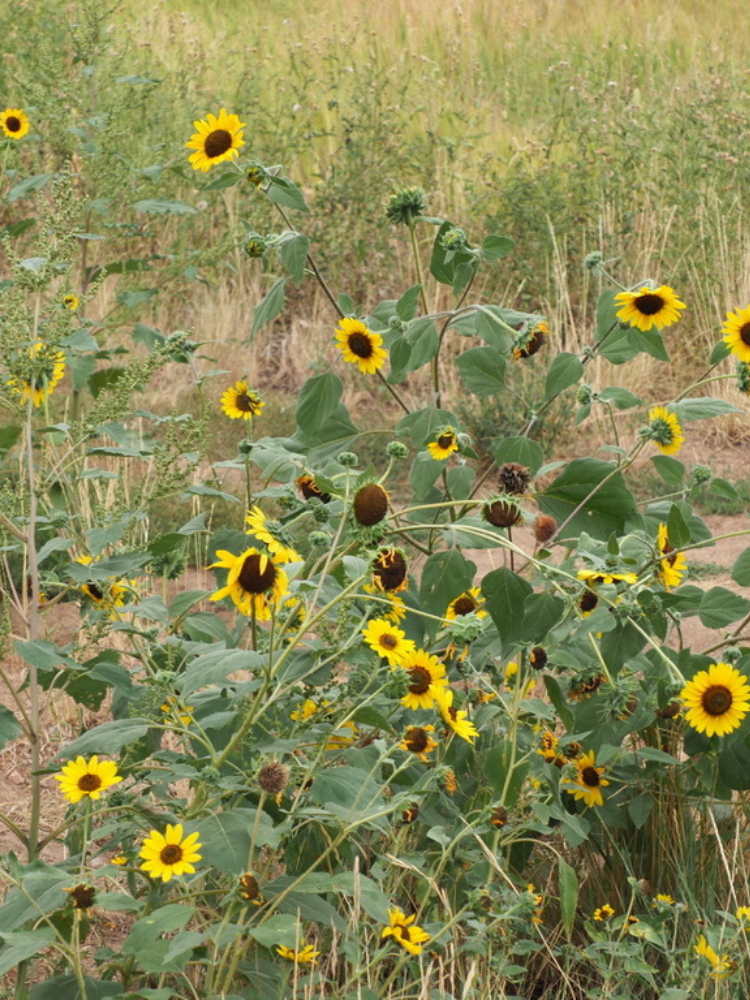
Common sunflower, Helianthus annuus,
a Colorado native plant! Photo: SPD
1. “Native plants” are defined as “plant species that are indigenous to the State of Colorado.” The ordinance refers to “the Colorado Native Plant Society [CONPS] recommended species list or the Colorado State University Extension native plant species list applicable to the Arkansas River Valley region.”Your content goes here. Edit or remove this text inline or in the module Content settings. You can also style every aspect of this content in the module Design settings and even apply custom CSS to this text in the module Advanced settings.
2. The gardener’s required “intent” is defined as “the deliberate cultivation or maintenance [of native plants] . . . for purposes of landscaping, pollinator support, water conservation, food production, or aesthetic enhancement of the property.
3. Finally, any native plant landscaping “must not constitute a nuisance under any other provision of this Code or applicable state law.”
The purpose of this article is to offer fellow native-plant enthusiasts some guidance and resources that will help them demonstrate that their landscape complies with Pueblo’s new weed ordinance.
- Pueblo’s Native Plants
In addition to the CONPS and CSU Extension resources, an excellent research tool is the United States Department of Agriculture’s Natural Resources Conservation Service’s PLANTS Database (“Plant List of Attributes, Names, Taxonomy, and Symbols”): https://plants.sc.egov.usda.gov/. The PLANTS Database entry for Helianthus annuus shows that it is a native plant throughout the “lower 48” states (L48 N) and has been introduced (I) in Alaska, Canada, Hawai’i, Puerto Rico, and St. Pierre and Miquelon:
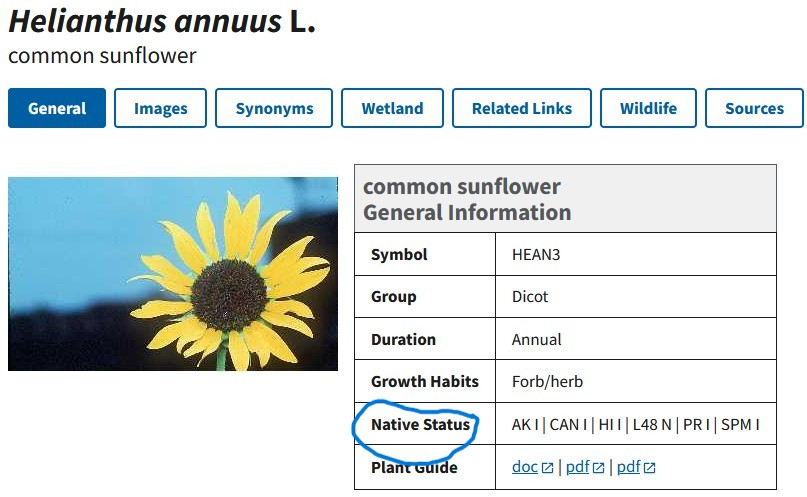
USDA NRCS’PLANTS Database
If Pueblo gardeners need assistance identifying a plant in their landscape or locating authoritative sources regarding a plant’s “native-ness,” the Pueblo County CSU Extension Office and volunteer CMGs want to help. The Help Line email address is pueblomastergardener@gmail.com and the phone number is (719) 583-6566.
1. Deliberate Cultivation
Our neighbors’ beliefs about “good” yards are shaped by our culture. After World War II, America’s “ideal” landscape became turf lawn dotted with decorative shrubs pruned into geometric shapes and well defined, colorful flower beds. In contrast, Pueblo’s native plants can appear wild.
I will never forget the late winter day my dad pulled up to our house and said in a not-so-subtle stage whisper, “Damn weeds!” Ouch! I could see beauty in our stark winter but he couldn’t.
Forty years ago, Professor Joan Nassauer introduced the concept of “Cues to Care,” gardening practices that we can adopt to communicate to passersby that our native-plant landscapes are intentional and lovingly maintained. Professor Nassauer called the results “messy ecosystems in orderly frames.”
Here are some of the design and maintenance techniques that demonstrate “deliberate cultivation.”
A. Flowers!
Like the pollinators we strive to support, human eyes are attracted to color. Everyone agrees: season-spanning blooms are beautiful.
B. Crisp Edges
Clear sidewalks and walking paths show empathy to pedestrians, delivery drivers, and visitors, and they also provide an important visual cue that our landscapes are intentional, designed and maintained as a welcoming place. Pueblo’s “ten-inch” height limit reflects a hard-wired human instinct to be wary of predators lurking in tall vegetation.
Establishing borders around planting beds is another visual cue of “deliberate cultivation.” Edging materials can be purchased, but natural materials like rocks and logs work well, too.
C. Regular Maintenance
All the items we add to our yards for the benefit of humans and wildlife – patio furniture, bird baths, bird feeders – are visual cues that our landscapes were intentionally designed for outdoor enjoyment, and they should be kept in tip-top shape. The same is true for other aspects of our hardscapes, like fences, sheds, and lawn ornaments. Additional chores include removing wind-blown trash, pet feces, and, of course, weeds.
1. Nuisances?
If you live on a corner, you need to be mindful of “sight lines.” These are the triangles at street intersections where drivers, bicyclists, and pedestrians need to be able to see oncoming traffic.

Used with permission: Newberry County, South Carolina, Code of Ordinances section 153.032
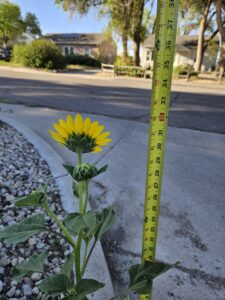
Sunflower removed from Line of Sight
Photo: Di Graski
Pueblo City Ordinance section 15-3-2(a)(3) prohibits anything “between two (2) and eight (8) feet above the immediately adjacent street grade” inside the sight triangle. In other words, Pueblo law expressly defines as a nuisance anything that could block visibility at an intersection. We live on a corner, and, alas, some of our sunflowers picked bad spots to grow. Measured from the street surface, they now top out at almost three feet, meaning we will have to remove them, for the sake of public safety.
- Homeowners Associations
An additional note for gardeners whose landscapes are also governed by HOA rules: Colorado Senate Bill 23-178 prohibits homeowners associations from outright banning native landscapes. The statute is a bit complicated – the rules depend on whether you live in a single-family detached home, a single-family home with a shared wall, or a condominium – but Colorado’s public policy is to encourage drought-tolerant landscaping, and Pueblo’s native plants are the champions of tolerating drought.
- Best Evidence of Intent?
An advocate of natural landscaping, Benjamin Vogt of Prairie Up explained in a 2025 webinar hosted by Homegrown National Park that the absolute best evidence of “intent” is to BE SEEN: show your neighbors with your hands-on efforts that your native plants are, indeed, deliberate. Be seen planting, watering, weeding, dead-heading, mulching – all the actions of gardening.
If your native plant landscape draws the attention of Code Enforcement, your garden journal might come to the rescue. Respectfully, calmly walking Code Enforcement Officers through your yard, introducing them to the native plants you have cultivated, and talking with them about your landscaping goals (key words: “pollinator support” and “water conservation”) seems like the best strategy to achieve dismissal of any complaint.
Di Graski
Colorado Master Gardener
Southeast Chapter Member
Colorado Native Plant Society
Resources
City of Pueblo’s Weed Ordinance, https://library.municode.com/co/pueblo/codes/code_of_ordinances?nodeId=TITVIIHESA_CH4WE_S7-4-1DE (amended by Ordinance 11136).
Colorado Native Plant Society, “Low-Water Native Plants for Colorado Gardens: Southeastern Colorado,” https://conps.org/waterwise-native-plants-by-region/.
“Colorado Plant Database,” https://coloradoplants.jeffco.us/plantAbout, “more than 1,000 Colorado native plants as well as non-native invasive weeds.”
Colorado Revised Statutes § 38-33.3-106.5(1)(i)(I)(A) & (1)(i.5), https://colorado.public.law/statutes/crs_38-33.3-106.5.
Sally Elmiger, “Cues to Care: The Language of Neighborly Landscaping,” Wild Ones Journal, 24(5), 1, 22-23 (2011) (available online at https://wildones.org/cues-to-care-the-language-of-neighborly-landscaping/).
Benjamin Vogt, Prairie Up, “How to Pass Weed Inspection – A True Life Story” (2018), https://prairieup.com/how-to-pass-weed-inspection-a-true-life-story/.